
Iconography / 07 ICONS
7 Wonder of the world
Seven landmarks. Seven architectural stories.
The New Seven Wonders of the World, interpreted as glass iconographies. Explore each landmark’s form, setting and history.

Great Wall of China
A network of defensive walls and watchtowers following the mountain ridges of northern China. The illustration traces its stone ramparts through a green, sunlit landscape.
View artwork ↗
Colosseum
Rome’s Flavian amphitheatre, built in the first century CE, is defined by its elliptical arena and tiers of arches. Warm stone and repeated arcades give this iconography its rhythm.
View artwork ↗
Taj Mahal
A seventeenth-century Mughal mausoleum commissioned by Shah Jahan in memory of Mumtaz Mahal. Its white marble dome, minarets and reflecting pool form a carefully balanced garden composition.
View artwork ↗
Petra
The Nabataean city of Petra is carved into rose-coloured sandstone cliffs. This scene focuses on Al-Khazneh, the Treasury, where an ornate rock-cut façade meets the canyon walls.
View artwork ↗
Machu Picchu
A fifteenth-century Inca site set high in the Andes. Agricultural terraces and finely fitted stone buildings follow the mountain contours beneath the peak of Huayna Picchu.
View artwork ↗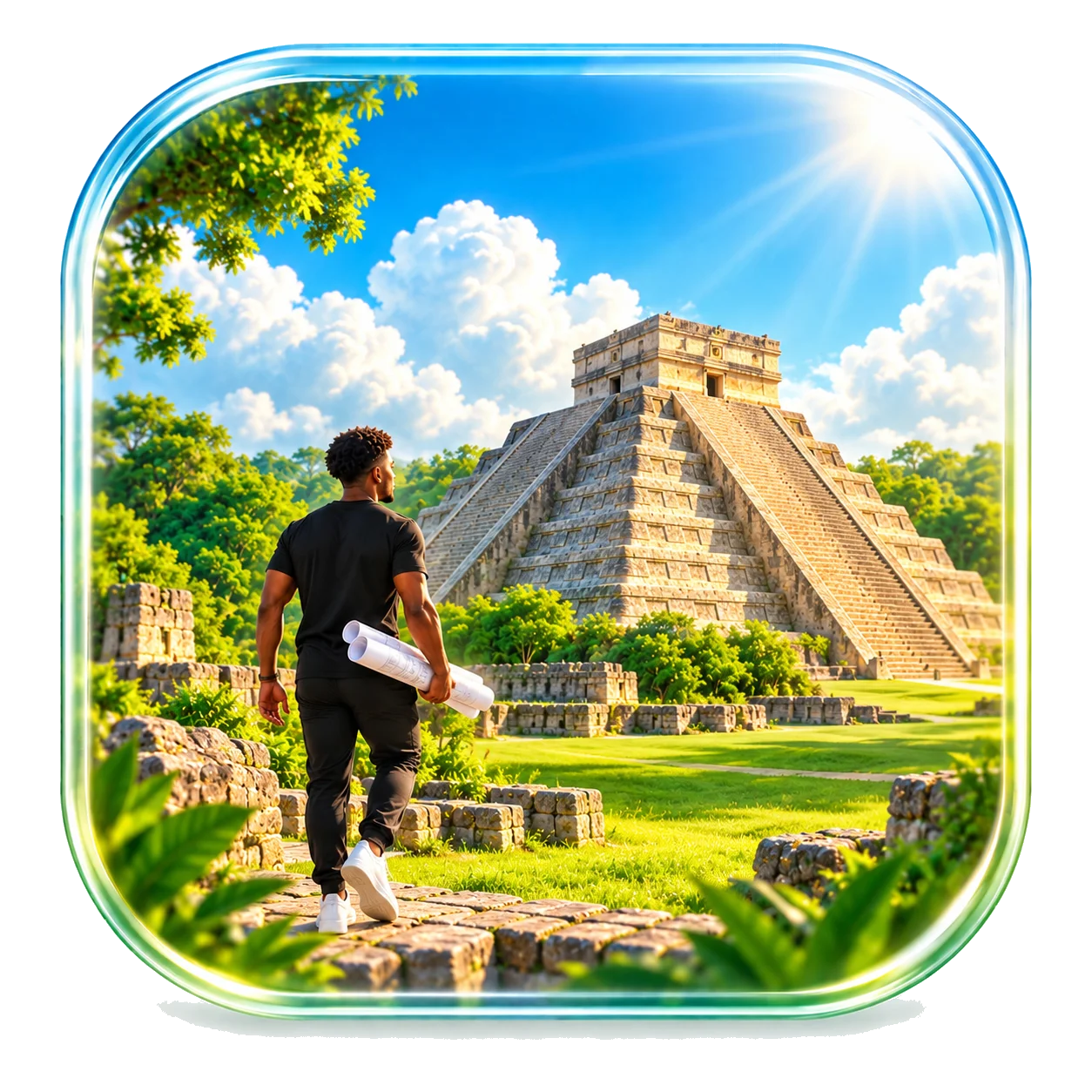
Chichén Itzá
A major Maya city whose Temple of Kukulcán, also known as El Castillo, rises above the surrounding landscape. Its stepped terraces and broad stairways express a precise monumental geometry.
View artwork ↗
Christ the Redeemer
Completed in 1931, this Art Deco statue stands on Corcovado above Rio de Janeiro. Its outstretched arms overlook forested slopes, the city and Guanabara Bay.
View artwork ↗← Back to Iconography · Explore the interactive Seven Wonders gallery ↗